
Skip to Content

Miscellanea

This is a list of articles with teasers.  The headlines below are links to the full articles.


The More They Stay as Useful

skip to next article

Someone just posted a YouTube video with the headline, Children aren’t Children Any More.

The problem with this is that they never were — or rather, every generation’s, or rather, every individual’s conception of child and adult (and whatever in-between stages they imagine) are a little different, though I suspect there’s a broader cultural conception composed of loosely compatible individual conceptions within specific societies, but that’s what shifts a little from generation to generation. So whatever this complainant’s conception is of childhood (and by implication adulthood), it wasn’t quite her parents’ conception and therefore probably not mine, and probably not yours. And her parents’ was not quite their parents’, and so on. Of course, it’s entirely possible that there is a vertical component in the transmission of the concept, so that different families will have different conceptions simultaneously.

One thing that is clear is that representing childhood, as in this video thumbnail, with stacked shelves in a toy store, would have been meaningless to much of the world a couple of generations ago, and to the entire world ten generations ago. Also that the same childhood might be a different thing from different perspectives; to one person this is your child and that usually has too many personal meanings to list. To another they’re a marketing mechanism, or a preaching opportunity, or a supply of labour, or of cannon fodder. The details change, but the last three? Children, sadly, are still the children they always were for those interested parties.

Fluids

skip to next article

I had this thought about gender-fluidity, which on consideration may illuminate the subject of gender more broadly.

Having met people who assert a variety of non-binary gender identities over the years, I’ve always been a little puzzled by the concept of fluidity, compared to gender as a reasonably constant thing. (In the absence of some major event requiring transition, though that’s more often a long-term mismatch rather than a specific event obvious to others.) I had no reason to disbelieve anyone, but I somehow didn’t get it.

I have considered that perhaps a very neutral position on the hypothetical feminine-to-masculine spectrum could produce a variable gender identity, if external influences could then overcome the neutral state. But that doesn’t clearly explain why there are people with fluid and people with consistently neutral identities. I also tend to think that masculinity-to-femininity as commonly practiced is not a single-dimensional spectrum, but rather a very approximate two-dimensional aggregate of characteristics which derive much of their imagined grouping from social influences anyway. However:

Perhaps We Flow

It occurred to me recently that another way of looking at it is that fluidity might be the norm. That is to say, that ordinary humans don’t necessarily have a real permanent sense of gender identity to begin with, rather than intermittent ones which are assumed and reified in between times. As someone once put it, I don’t wake up every morning and immediately think oh-my-god-I’m-a-woman.’

more →


An Offering to the Goths

skip to next article

(Found this again and thought I might as well post it.)

slowly, near-disbelieving,
in our blindfold race to be, or
to perceive what truth may lie untamed
beyond the worldʼs analgesic persuasions,
together we pieced
these clues and visions
seized from our
inculcated dreams,
and so, discerned
its trail of shame,
grasped, and so saw past
its dress and painted finery,
and within, beheld at last
the tortured face
of true horror;
and so finally,
we have learned
its dismal name:
normality

‘an offering to the goths’ electropict 2019

Learn to Breathe Again

skip to next article

Sometimes you seem to leave messages for your future self. I found this scribble in a box of 20-year-old documents I was sorting through.

In the moment of your birth you began to learn to breathe, inhaling air, exhaling; crying at first; it was as new to you as you to the world. But you had an instinct for it. What didn’t come naturally came before long through learning — when to breathe and when not to breathe, and when to breathe in and when to breathe out. I assume this is all true, because you’re still alive.

And yet the strange thing is, you’re not happy. I wonder why we don’t have the same instinct for happiness we have for air. We know somewhere that once a moment’s joy is in us we have to let it go again lest it turn stale and choke us . . . yet it seems difficult to turn this knowledge into action . . . as if we spent our days turning red in the face and moaning about letting the moment’s breath go.

So learn: Each moment of joy is that moment’s joy; it cannot be grasped without halting the flow of happiness by which you live. Breathe it out, use it for speech or for song, but at all events, do not seek to squeeze it within you and suck up more without letting the old air go. Learn to breathe again.

Happiness is like breathing. You cannot hold a breath for long lest it turn stale and choke you, but you learned to breathe it seems . . .  You must also learn to exhale this moment’s happiness and allow the next moment’s joy in.

(Update: Since people seem to like it, here it is as a printable PDF.)


A Denominationally Unique Phenomenon?

skip to next article

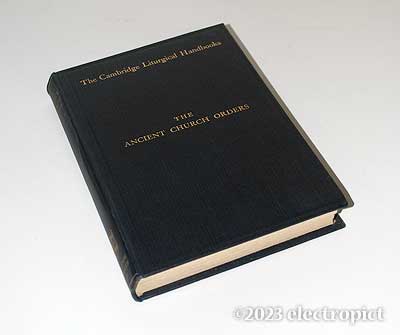
I’m in the midst of sorting some books with a view to rationalising their shelving, and have come across one I bought, probably in the late 1990s, possibly at the secondhand book shop in Broadford, probably in a hurry. The Ancient Church Orders by Arthur John MacLean (Cambridge University Press, 1910). As I recall, the text was not what I had expected and of little interest, but I remember none of the detail — in part because of a distraction it contained. Its previous owner had left within the most remarkable bookmark I have ever encountered.

MacLean, The Ancient Church Orders

At some point in its life, probably when new, the book had been owned by one Reverend H.S. Sard (CoE), initially at Cuddesdon College,[1] and later at Upper Norwood, London, England. I doubt I am the first owner since; several decades may have elapsed in between. Rev. Sard had in 1942 (probably December) received [2] a letter from someone whom (it indicates) he had assisted financially towards what appears to have been a form of missionary endeavour in Barcelona. I had no idea that Anglican missionaries went to the Continent in the early 20th Century, even if — as seems likely in this instance — they went of their own accord. In fact I cannot say whether the writer was in any sense representative of contemporary Anglicans or their missionaries — or perhaps not an Anglican at all, but a denominationally unique phenomenon, though with some Anglican friends?

Rev. Sard’s Bookmark

I assume Rev. Sard read it, and I cannot presume to guess his feelings regarding either the letter or the missionary — though this was one of a series of communications, so probably he was familiar with the style. He then returned it to its envelope and appears to have used it thereafter as a bookmark. (A habit which, as its later discoverer, I must heartily commend.) The picture shows where it appears to have spent time stuck out of a book at one end and become sun-scorched and perhaps a little smoke-stained. [3]

hbm’s envelope, open, with letter

I am about as far from an expert on 20th Century Anglican — or other Christian — or in fact any religion’s — missionaries as it is possible to be, but so far as I know this is the only surviving record of HIS BARCELONA MESSENGER. (Transcription below.) I would be interested to hear about any other records or memories which do still exist.

more →


broken

(This is the last article listed on this page.  Skip to page navigation.)

I read a line on a webpage a while back. Admittedly, at the time I thought — hah, sounds kind of right — and moved on. But it’s been niggling at me, and I ended up realising, no, not right. So I had to go back and find it, failed, failed to accurately remember the words, but by the marvel of search engines found what I think is the original (or at least, where it was as it seems now to be behind a paywall, but I’ve found it on the Internet Archive):

The world is so big, so complicated, so replete with marvels and surprises that it takes years for most people to begin to notice that it is, also, irretrievably broken. We call this period of research childhood.”

— Michael Chabon in the New York Book Review, 2013–01-31

The implication I understood in the context I first read (still haven’t found it) is that adults are those who have noticed that the world is irretrievably broken. And it’s that implication (which might not be the whole point in the original) to which I have to respond with an unambiguous no.

The state of mind in which we view the world as irretrievably broken might be better characterised as mopey-teenager, rather than adult. The idea goes quite well with the denial and depression stages of grieving. But really an adult — well, what do we mean by adult? A mature person? I know these words are all a bit tendentious, but there’s a point behind them, and I think it’s this:

Maturity requires acceptance. In this case, acceptance that we just live in the world, we didn’t design or make it, and it never did respond to our desires and preconceptions more than coincidentally. To consider the world broken because it doesn’t meet your expectations is not mature. (Or at least, very far from enlightened.)

To be sure, there are people who are legally adults who haven’t moved on from the mopey-teenage viewpoint; which shouldn’t be surprising as there are those of all ages who haven’t moved on from childlike marvel and surprise either. And whether it was originally intended this way or not, the quote, used by those who are still stuck in the adolescent phase, serves to infantilise those who have managed by good fortune or neurological peculiarity to skip it, or those who haven’t yet reached it. Misery loves company.

Hopefully this doesn’t come across as just an attempt to infantilise . . . well, juvenalise? . . . those who are stuck in denial and depression with regard to the world around them. I didn’t skip it, though I don’t think I’m irretrievably trapped in it either. Because: it’s not the end of the process. If you think the world is broken, it’s time to move on. Your expectations may indeed be broken, but the world is as complete and ever-changing as it always was.

I suspect enlightened maturity loves company too. If I get there I’ll let you know.


◀◀ latest posts  |  ◀ newer  |  older ▶  |  oldest posts ▶▶